NEUROPSYCHOLOGICAL PROFILE OF AN ADOLESCENT WITH DUCHENNE MUSCULAR DYSTROPHY: A CASE STUDY
Abstract
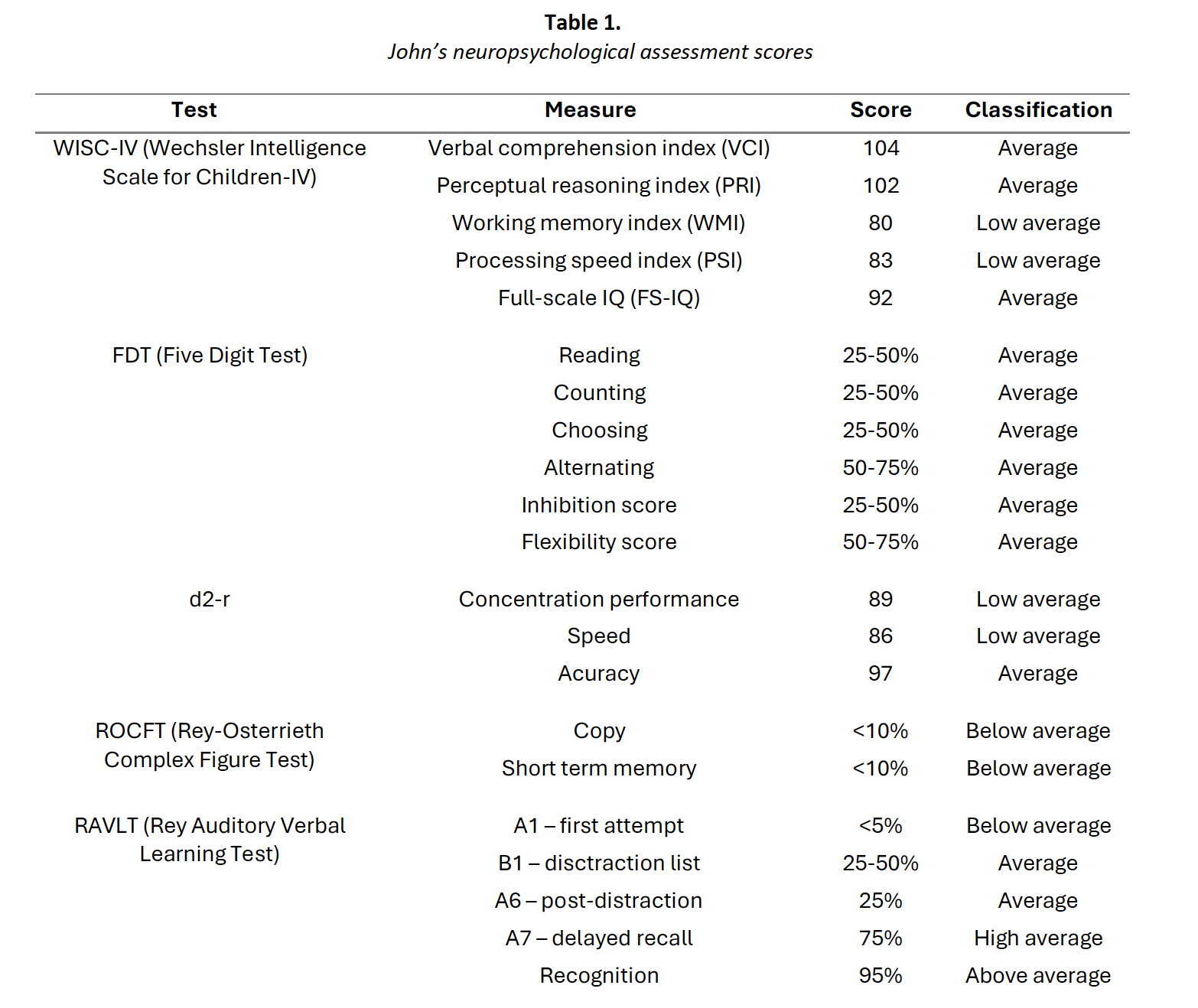
Duchenne Muscular Dystrophy (DMD) is one of the most common diseases that leads to muscle wasting. It is a recessive and hereditary congenital disorder, affecting mostly males. It is caused by alterations in the expression of the Xp21 segment of the X chromosome, which is responsible for regulating the production of the dystrophin protein. Due to the association between the lack of dystrophin and cortical post-synaptic neural atrophy, DMD is associated with a high likelihood of cognitive impairment, especially in reasoning, executive functions, and academic performance. This study presents a case report detailing a neuropsychological assessment conducted on a 14-year-old boy with DMD. The main objective was to comprehend the underlying reasons for the patient’s low academic performance. The assessment included measures of reasoning, attention, language skills, executive functioning, memory, and academic performance. The findings are on par with international literature, demonstrating that there are neuropsychological impairments even in the absence of a deficit in IQ. Notably, this study identified that language and academic achievement may be significantly impacted, which had not been thoroughly explored in the scientific literature. Thus, it can be concluded that understanding the impacts of DMD beyond the physical symptoms could enhance support for affected individuals worldwide.
Downloads
Published
How to Cite
Issue
Section
License
Copyright (c) 2025 Luana Breda, Genner Mateus Secco , Gabriel Sousa Andrade

This work is licensed under a Creative Commons Attribution-NonCommercial-ShareAlike 4.0 International License.
Articles published in this journal are protected under the Creative Commons Attribution-NonCommercial-ShareAlike 4.0 International (CC BY-NC-SA 4.0) license. This means that authors retain full rights over their research and publications at all times. As a journal, we fully respect and promote the principles of open access established by this license, allowing the work to be shared, adapted, and distributed for non-commercial purposes, provided that appropriate credit is given to the authors and any derivative works are licensed under the same terms.
Authors are responsible for obtaining the required permission when they wish to reproduce part of the material (figures, etc.) from other publications.
Likewise, CNPs allows authors to host in their personal sites or other repositories that they deem convenient the Final and Definitive Version of the published article with the format assigned by the journal. In no case do we allow access to preprints of the article under evaluation or already published.
When submitting an article to CNPs you are aware that all the contents of CNPs are under a Creative Commons License. In which it is allowed to copy and share the contents freely, always making reference to the origin of the publication and its author.