DYNAMICS OF SLEEP SPINDLES IN CHILDREN WITH DOWN SYNDROME: A PILOT STUDY OF ELECTROENCEPHALOGRAPHIC MICROARCHITECTURE
Abstract
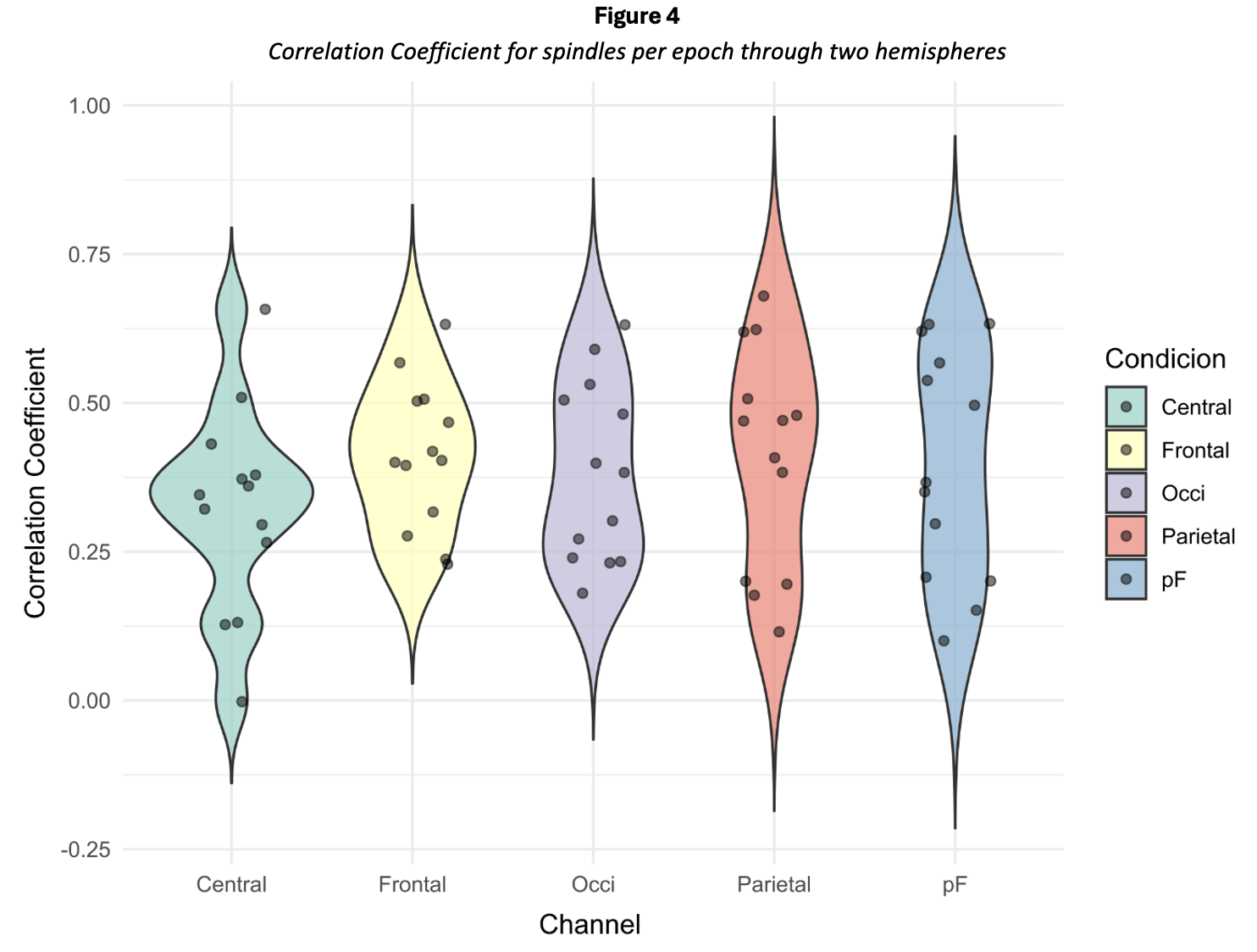
Objective: To characterize the topographic distribution, density, and interhemispheric synchrony of sleep spindles in children with Down syndrome using retrospective analysis of polysomnographic data. Methods: Polysomnographic recordings from 13 children with Down syndrome were analyzed. Spindle detection was performed using bandpass filtering, Hilbert transform, and amplitude thresholding during N2 sleep. Spindle density, symmetry between hemispheres, and topographic patterns were assessed. Results: Children with Down syndrome exhibited increased slow-wave sleep (N3) and reduced REM sleep compared to normative values. Sleep spindles showed a predominance in posterior and left-hemisphere regions. Fast spindles (14–16 Hz) were more densely distributed than slow spindles (10–13 Hz), and statistical differences in spindle density were found across channels. Interhemispheric synchrony was moderate but not statistically significant. Conclusions: Alterations in sleep spindle architecture and distribution were observed in children with Down syndrome. These findings suggest a potential link between spindle patterns and neurodevelopmental processes in this population, warranting further investigation.
Keywords: Down syndrome; Sleep spindles; EEG; neurodevelopment; Polysomnography.
Downloads
Published
How to Cite
Issue
Section
License
Copyright (c) 2026 María Olga Retamal, J. Amaro-Fuenzalida, Tomás Mesa Latorre, Jovita Corzo Lameiro, Tomás Ossandón Valdés, Juan Pablo Retamal Rosales, Gregorio Sierra Del Villar

This work is licensed under a Creative Commons Attribution-NonCommercial-ShareAlike 4.0 International License.
Articles published in this journal are protected under the Creative Commons Attribution-NonCommercial-ShareAlike 4.0 International (CC BY-NC-SA 4.0) license. This means that authors retain full rights over their research and publications at all times. As a journal, we fully respect and promote the principles of open access established by this license, allowing the work to be shared, adapted, and distributed for non-commercial purposes, provided that appropriate credit is given to the authors and any derivative works are licensed under the same terms.
Authors are responsible for obtaining the required permission when they wish to reproduce part of the material (figures, etc.) from other publications.
Likewise, CNPs allows authors to host in their personal sites or other repositories that they deem convenient the Final and Definitive Version of the published article with the format assigned by the journal. In no case do we allow access to preprints of the article under evaluation or already published.
When submitting an article to CNPs you are aware that all the contents of CNPs are under a Creative Commons License. In which it is allowed to copy and share the contents freely, always making reference to the origin of the publication and its author.