VERBAL AUDITORY SCREENING OF COGNITIVE ALTERATIONS TEST (CAVAC): EFFECT OF DEMOGRAPHIC VARIABLES AND ARGENTINE NORMATIVE DATA
Abstract
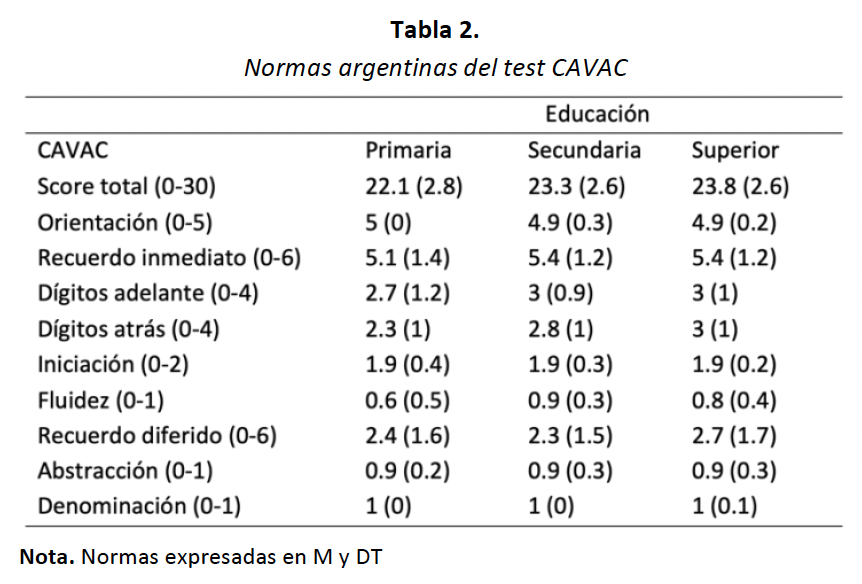
An increase in dementia is projected in the coming years, with Latin America being one of the most affected regions. Given this situation, new and improved tests for early detection are needed. The objective of this study was to obtain normative data for a recently developed test, the Verbal Auditory Screening of Cognitive Alterations Test (CAVAC), and to investigate the potential effects of demographic variables on its performance. 363 Argentinians from the general population (mean age: 66.2 years) were assessed using the CAVAC. Bivariate and regression analyses were performed to determine the influence of education, age, and sex on CAVAC performance. Education had a positive and significant influence on CAVAC performance. Furthermore, a negative correlation was found between age and CAVAC performance, and women showed better performance; however, these analyses for age and sex did not reach statistical significance. Argentinian norms were developed according to educational level. Further normative studies are suggested that include a larger number of adults with low educational attainment and a higher proportion of men.
Keywords: cognitive functions; neuropsychological assessment; screening test; cognitive performance; normative data.
▶ VER VIDEO ABSTRACT DE LOS AUTORES AQUÍ
Downloads
Published
How to Cite
Issue
Section
License
Copyright (c) 2026 Pablo Martino, Camila Martín, Mauricio Cervigni

This work is licensed under a Creative Commons Attribution-NonCommercial-ShareAlike 4.0 International License.
Articles published in this journal are protected under the Creative Commons Attribution-NonCommercial-ShareAlike 4.0 International (CC BY-NC-SA 4.0) license. This means that authors retain full rights over their research and publications at all times. As a journal, we fully respect and promote the principles of open access established by this license, allowing the work to be shared, adapted, and distributed for non-commercial purposes, provided that appropriate credit is given to the authors and any derivative works are licensed under the same terms.
Authors are responsible for obtaining the required permission when they wish to reproduce part of the material (figures, etc.) from other publications.
Likewise, CNPs allows authors to host in their personal sites or other repositories that they deem convenient the Final and Definitive Version of the published article with the format assigned by the journal. In no case do we allow access to preprints of the article under evaluation or already published.
When submitting an article to CNPs you are aware that all the contents of CNPs are under a Creative Commons License. In which it is allowed to copy and share the contents freely, always making reference to the origin of the publication and its author.