GRADIENTAL APPROACH TO HUMAN PREFRONTAL CORTEX FUNCTIONAL ORGANIZATION: BEYOND THE MODULAR HYPOTHESIS
Abstract
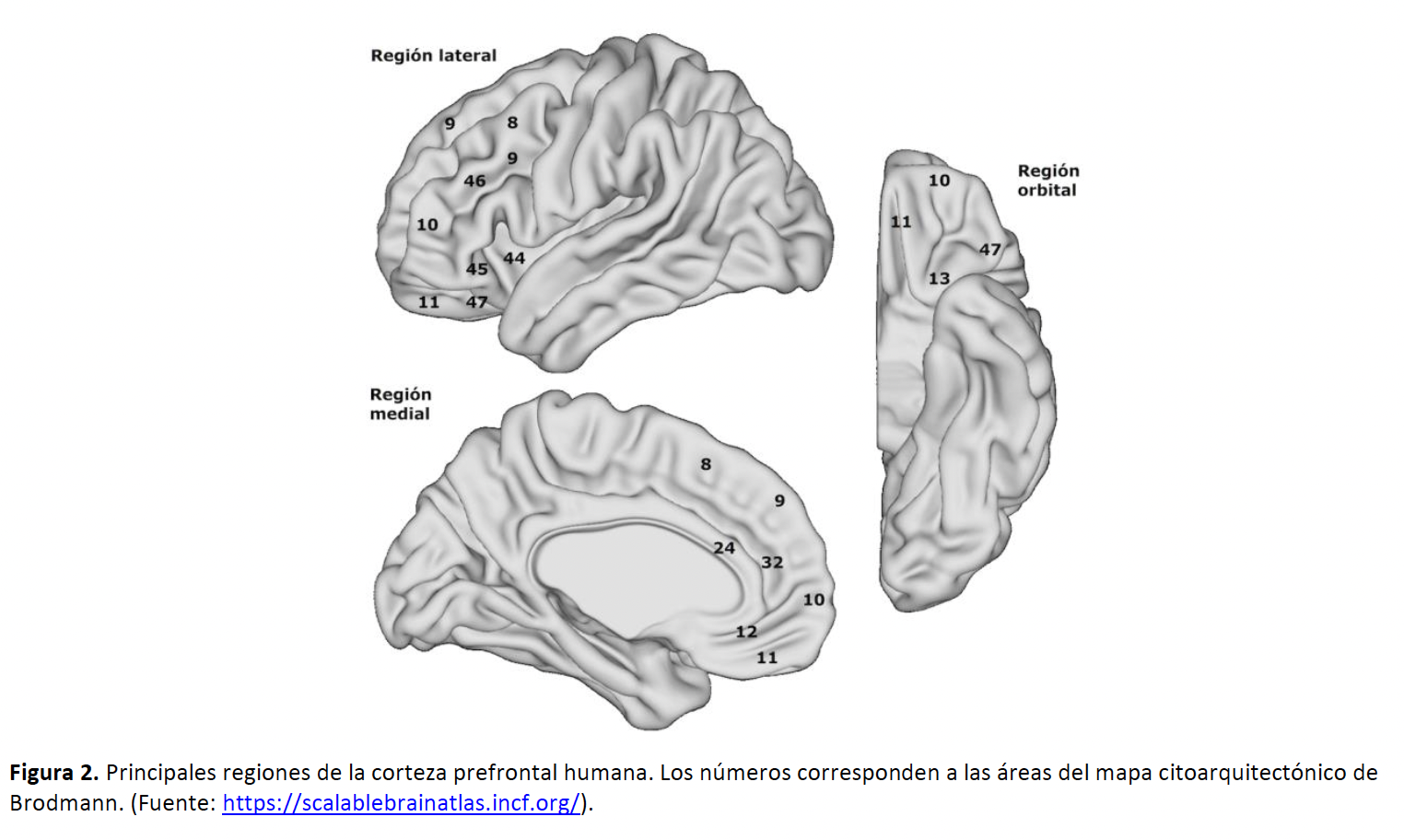
Introduction. Humans can generate flexible behaviors, in which the consequence determines the behavior, thanks to anticipatory proaction processes. This behavioral versatility derives from the action of the central nervous system, within the prefrontal cortex (PFC) plays a key role. Development. Neurobiology has attempted to unravel the functional organization of the PFC from two theoretical frameworks. The first speculates that its operational capacity is based on its anatomical-functional architecture formed by regions responsible for different brain processes (the PFC is usually divided into three large specialized functional regions: lateral, medial and orbital). The second considers that it is organized in anatomical-functional axes or gradients (specifically, a rostro-caudal axis, a dorsal-ventral axis and a latero-medial axis). Conclusions. The division of the PFC into anatomical-functional regions imagines this brain structure as a mosaic of specialized areas. In contrast to this static division of the PFC, the axis (or gradient) approach proposes that anatomically adjacent regions are involved in similar computational processes, giving rise to gradual transitions from one process to another in a continuous and gradual trajectory..
Downloads
Published
How to Cite
Issue
Section
License
Copyright (c) 2025 Alberto García-Molina

This work is licensed under a Creative Commons Attribution-NonCommercial-ShareAlike 4.0 International License.
Articles published in this journal are protected under the Creative Commons Attribution-NonCommercial-ShareAlike 4.0 International (CC BY-NC-SA 4.0) license. This means that authors retain full rights over their research and publications at all times. As a journal, we fully respect and promote the principles of open access established by this license, allowing the work to be shared, adapted, and distributed for non-commercial purposes, provided that appropriate credit is given to the authors and any derivative works are licensed under the same terms.
Authors are responsible for obtaining the required permission when they wish to reproduce part of the material (figures, etc.) from other publications.
Likewise, CNPs allows authors to host in their personal sites or other repositories that they deem convenient the Final and Definitive Version of the published article with the format assigned by the journal. In no case do we allow access to preprints of the article under evaluation or already published.
When submitting an article to CNPs you are aware that all the contents of CNPs are under a Creative Commons License. In which it is allowed to copy and share the contents freely, always making reference to the origin of the publication and its author.