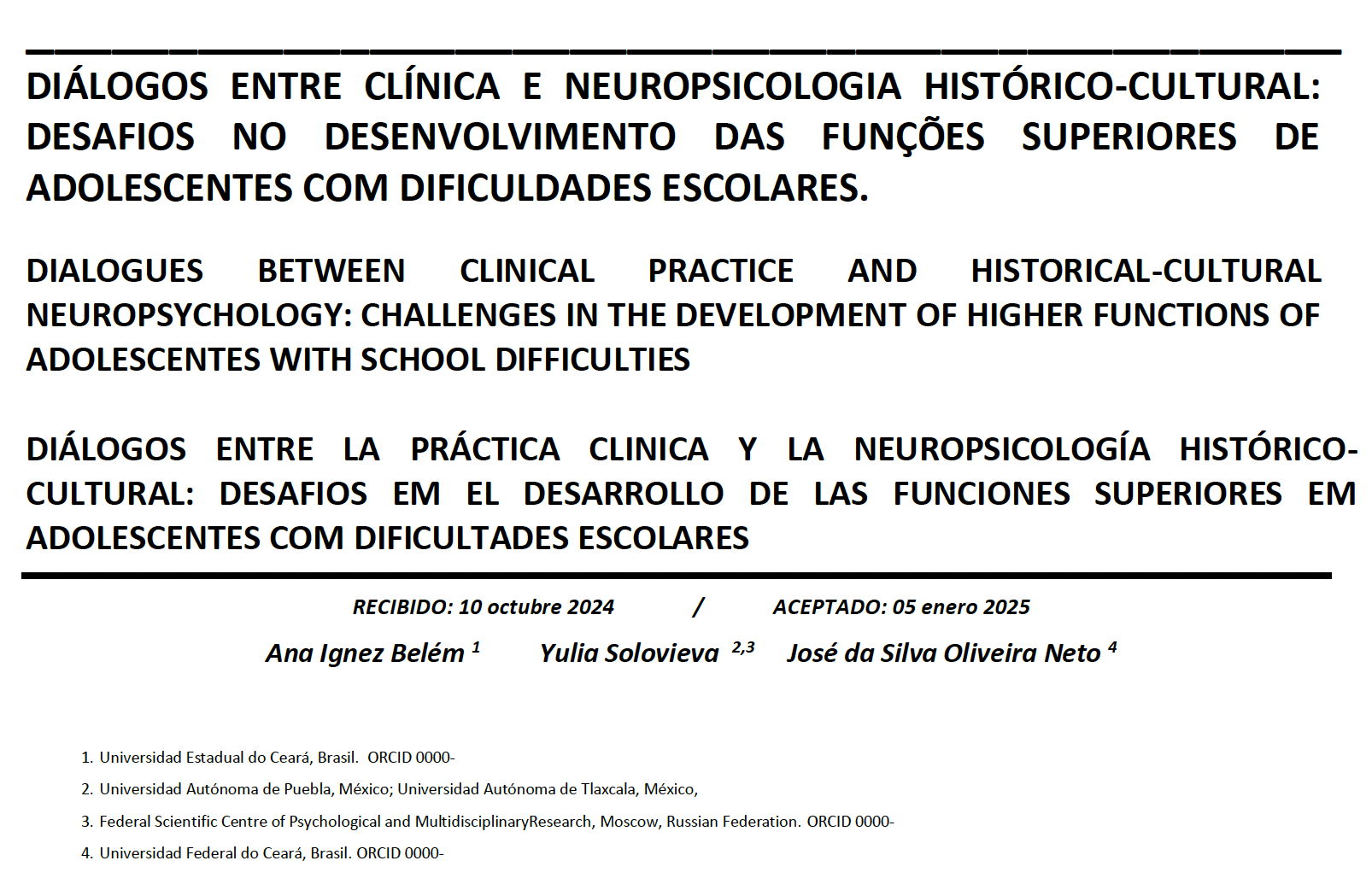
DIALOGUES BETWEEN CLINICAL PRACTICE AND HISTORICAL-CULTURAL NEUROPSYCHOLOGY: CHALLENGES IN THE DEVELOPMENT OF HIGHER FUNCTIONS OF ADOLESCENTES WITH SCHOOL DIFFICULTIES
Abstract
The objective of this study is to discuss how the historical-cultural clinic and the historical-cultural neuropsychology has been working with adolescents with learning difficulties, with the aim of transforming the activity of individuals to their full development. The theories of Vygotsky and Luria were used as an idea to understand development in the period of adolescence and its crisis. Several intervention strategies were presented in psychological functions, based on the modification and analysis of school activities. The studies show that the historical-cultural clinic is that the difficulties of learning should not be seen as a destination, something is inmutable. They are challenges that can be faced with proper intervention.Por el contrario, son retos que pueden ser afrontados con una intervención adecuada. By recognizing the importance of social, cultural, and emotional interactions in cognitive development, we can develop more effective and inclusive educational practices that enable adolescents with learning disabilities to advance their developmental potential as active, critical, autonomous, and entitled.
Downloads
Published
How to Cite
Issue
Section
License
Copyright (c) 2025 Ana Ignez Belém , Yulia Solovieva , José da Silva Oliveira Neto

This work is licensed under a Creative Commons Attribution-NonCommercial-ShareAlike 4.0 International License.
Articles published in this journal are protected under the Creative Commons Attribution-NonCommercial-ShareAlike 4.0 International (CC BY-NC-SA 4.0) license. This means that authors retain full rights over their research and publications at all times. As a journal, we fully respect and promote the principles of open access established by this license, allowing the work to be shared, adapted, and distributed for non-commercial purposes, provided that appropriate credit is given to the authors and any derivative works are licensed under the same terms.
Authors are responsible for obtaining the required permission when they wish to reproduce part of the material (figures, etc.) from other publications.
Likewise, CNPs allows authors to host in their personal sites or other repositories that they deem convenient the Final and Definitive Version of the published article with the format assigned by the journal. In no case do we allow access to preprints of the article under evaluation or already published.
When submitting an article to CNPs you are aware that all the contents of CNPs are under a Creative Commons License. In which it is allowed to copy and share the contents freely, always making reference to the origin of the publication and its author.