THE ARCHITECTURE OF READING ACQUISITION: PHONOLOGICAL AND LEXICAL SKILLS AS MARKERS OF COMPREHENSION IN SECOND GRADE
Abstract
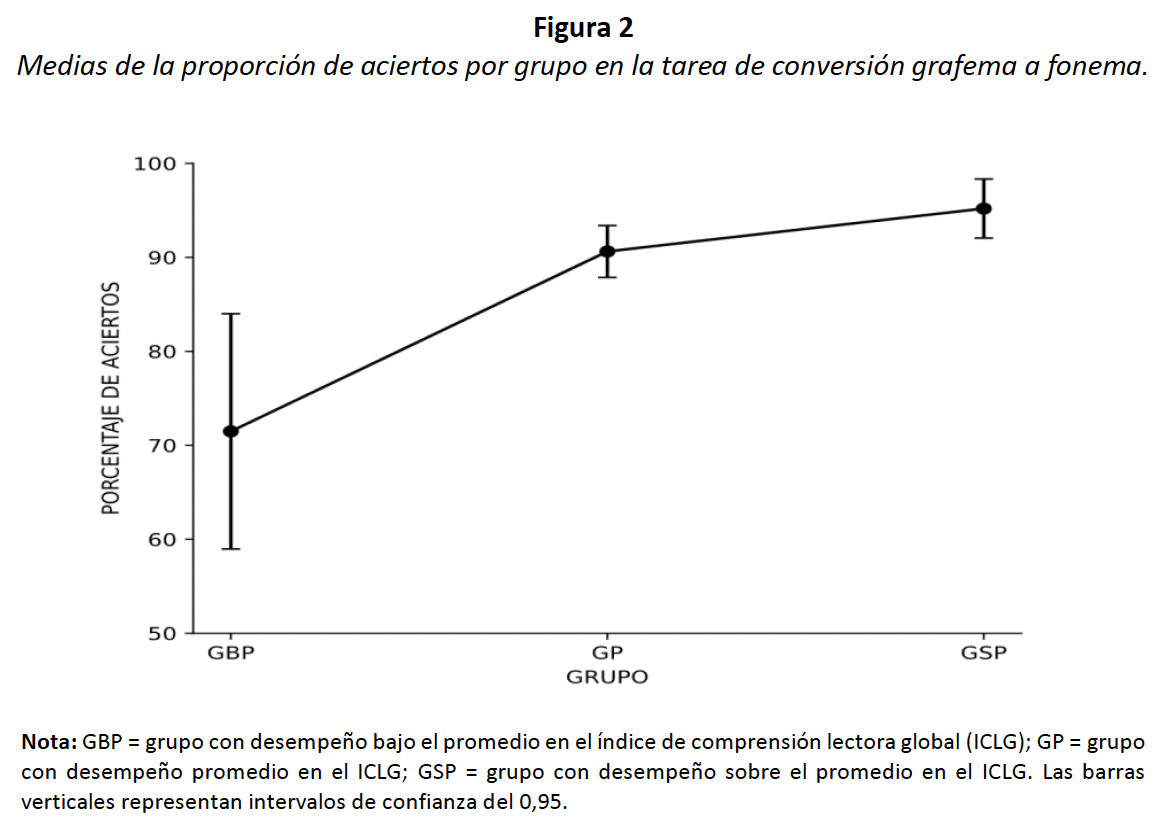
In the early school years, reading comprehension emerges from the interaction between sublexical phonological processes and lexical skills. The relative importance of these processes varies according to the stage of development and level of reading performance. This study aimed to describe the differential profile of phonological and lexical skills in second-grade elementary school students with transparent spelling, according to their reading comprehension performance. A quantitative, cross-sectional, comparative study was conducted with 75 Chilean schoolchildren, who were classified into three groups based on their scores on the Global Reading Comprehension Index of the ELFE II test. Computerised language skills tasks were administered and non-parametric comparative analyses were performed. The results showed that grapheme-to-phoneme conversion was the most effective skill for distinguishing between the groups, followed by phonemic synthesis and initial phoneme identification; meanwhile, vocabulary was most effective at distinguishing the lowest-performing group. These findings provide evidence on reading development in Spanish-speaking populations and highlight the importance of neuropsychological assessments with a dimensional approach for identifying early risk profiles.
Keywords: reading comprehension; phonological skills; vocabulary; transparent spelling; empirical article.
Published
How to Cite
Issue
Section
License
Copyright (c) 2026 Danilka Castro-Cañizares, Tatiana Mazuera-Velázquez, Allison V. Zomosa, Tania C. Fredes

This work is licensed under a Creative Commons Attribution-NonCommercial-ShareAlike 4.0 International License.
Articles published in this journal are protected under the Creative Commons Attribution-NonCommercial-ShareAlike 4.0 International (CC BY-NC-SA 4.0) license. This means that authors retain full rights over their research and publications at all times. As a journal, we fully respect and promote the principles of open access established by this license, allowing the work to be shared, adapted, and distributed for non-commercial purposes, provided that appropriate credit is given to the authors and any derivative works are licensed under the same terms.
Authors are responsible for obtaining the required permission when they wish to reproduce part of the material (figures, etc.) from other publications.
Likewise, CNPs allows authors to host in their personal sites or other repositories that they deem convenient the Final and Definitive Version of the published article with the format assigned by the journal. In no case do we allow access to preprints of the article under evaluation or already published.
When submitting an article to CNPs you are aware that all the contents of CNPs are under a Creative Commons License. In which it is allowed to copy and share the contents freely, always making reference to the origin of the publication and its author.