EMPATHY AS A NEUROBIOLOGICAL DIVIDER: TOWARD A DIFFERENTIAL DIAGNOSIS BETWEEN PSYCHOPATHY AND ANTISOCIAL PERSONALITY DISORDER
Abstract
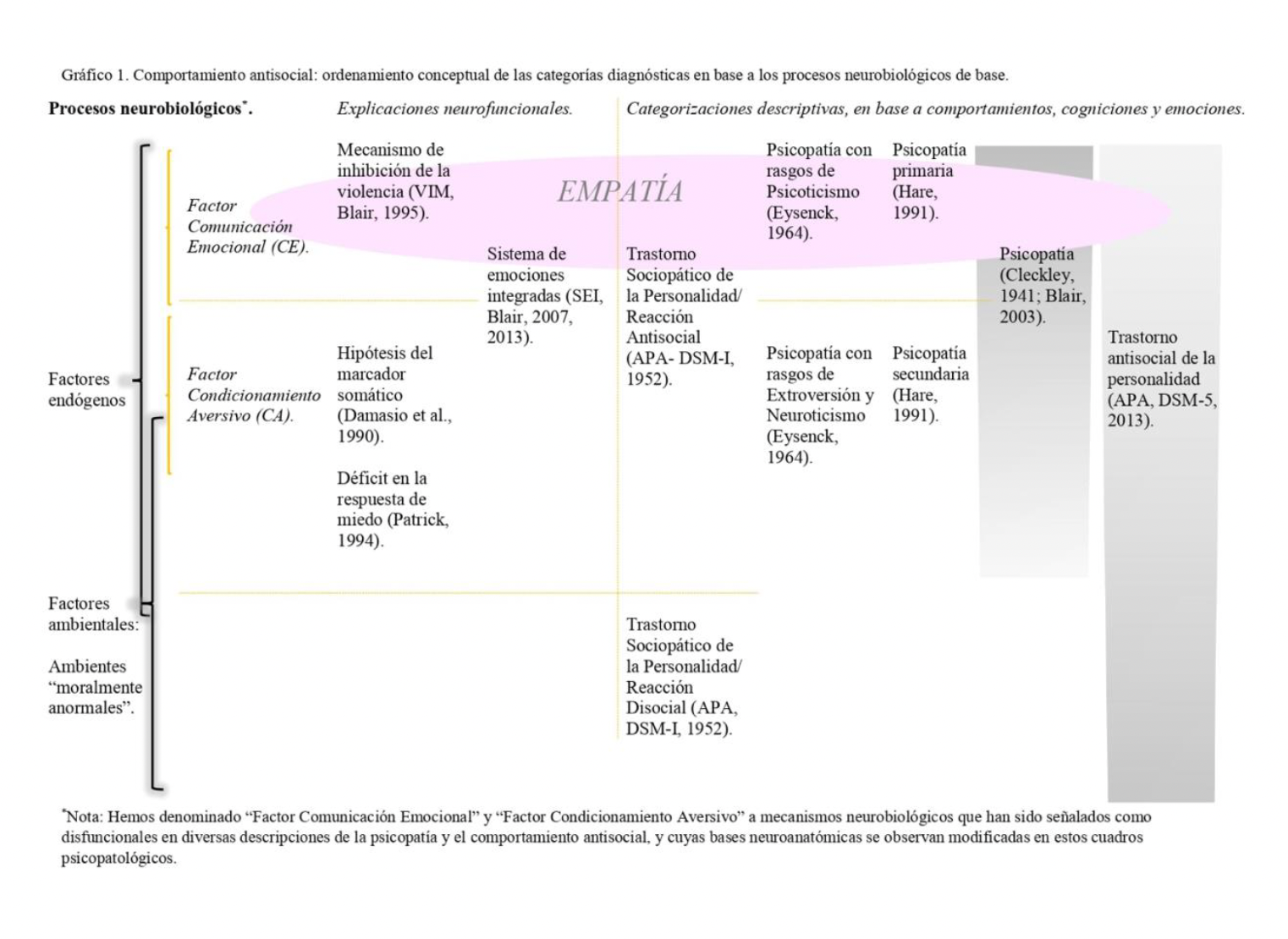
The diagnosis and treatment of disorders characterized by antisocial behavior and lack of empathy are still under development. Despite efforts to clarify the conceptual field, the overlap between the categories of psychopathy and antisocial personality disorder (ASPD) persists, and treatments remain largely ineffective. To improve differential diagnosis and therapeutic effectiveness, it has been proposed to integrate the behavioral approach of diagnostic manuals with other levels of analysis, such as the neurobiological. This work reviews current knowledge on the neurobiological bases of antisocial behavior, focusing on empathic deficits as a key factor for differentiating psychopathy and ASPD. It includes a historical overview of the parallel development of both categories and the associated neurobiological evidence. Finally, it discusses the diagnostic relevance of distinguishing between the two conditions and proposes an organizing model based on neurobiological profiles. Psychopathy could be characterized by an “emotional deficit” associated with hypo-reactivity to stress, while antisocial behavior in ASPD may result from that same profile or from a hyper-reactive one, not necessarily involving deficits in the biological foundations of empathy.
Downloads
Published
How to Cite
Issue
Section
License
Copyright (c) 2025 Mariana Beatriz López

This work is licensed under a Creative Commons Attribution-NonCommercial-ShareAlike 4.0 International License.
Articles published in this journal are protected under the Creative Commons Attribution-NonCommercial-ShareAlike 4.0 International (CC BY-NC-SA 4.0) license. This means that authors retain full rights over their research and publications at all times. As a journal, we fully respect and promote the principles of open access established by this license, allowing the work to be shared, adapted, and distributed for non-commercial purposes, provided that appropriate credit is given to the authors and any derivative works are licensed under the same terms.
Authors are responsible for obtaining the required permission when they wish to reproduce part of the material (figures, etc.) from other publications.
Likewise, CNPs allows authors to host in their personal sites or other repositories that they deem convenient the Final and Definitive Version of the published article with the format assigned by the journal. In no case do we allow access to preprints of the article under evaluation or already published.
When submitting an article to CNPs you are aware that all the contents of CNPs are under a Creative Commons License. In which it is allowed to copy and share the contents freely, always making reference to the origin of the publication and its author.